
Top Signs You Need Air Duct Cleaning Service – Don’t Ignore These
Dust on your registers isn’t a sign your ducts need cleaning. It’s normal accumulation from airflow turbulence at the grille. The sign that actually matters is dust reappearing 48 hours after you wipe them clean, because that means the blower is mobilizing debris from inside the system every time it runs. If that sounds familiar, the real question isn’t whether your ducts are dirty, it’s what kind of debris is sitting in them and how it’s getting pushed into your rooms. If you’d rather not climb around with a flashlight and a shop vacuum, call (855) 812-5163. We answer 24/7.
Why Most “Duct Cleaning Sign” Lists Miss the Point
Most articles on this topic hand you a checklist: dusty vents, musty smell, visible mold, allergies acting up. All of those are real, but a checklist tells you nothing about what’s happening inside the system. Two homes can both have dust on their registers for completely different reasons, and only one of them needs duct cleaning. The other might just need a better filter and a sealed return.
We’ve seen this play out in Kirkland homes enough times to know the pattern. The warning signs that matter are the ones tied to cause and effect: what happens when the system runs, what happens when it stops, and how quickly a symptom comes back after you address it. A symptom with a mechanism behind it is worth acting on. A symptom without one is just housekeeping.
Here’s what to look for, and more importantly, what each sign is actually telling you.
Sign #1: Dust Reappears on Registers Within Two Days
Wipe a supply register clean with a damp cloth. If it’s coated again in 48 hours, the dust isn’t coming from your room. It’s coming from inside the duct run feeding that register. When the blower kicks on, air moves through the trunk and branches at speed, and any loose debris sitting on the duct floor gets picked up and carried to the nearest grille. That’s why the dust lands in the same spots over and over.
The volume matters. A light film after a week is normal in any Kirkland home, especially during a dry stretch when outdoor particulate is high. A visible layer after two days is a load problem, not a surface problem. You can confirm it by checking a return grille: if the return is dirtier than the supplies, debris is collecting upstream and getting redistributed through the whole system.
- Light, even film across all registers: normal airflow turbulence. Wipe and move on.
- Heavy buildup at two or three registers only: localized debris in those branches. Worth an inspection.
- Heavy buildup everywhere, return grille included: active debris load system-wide. This is when cleaning pays off.
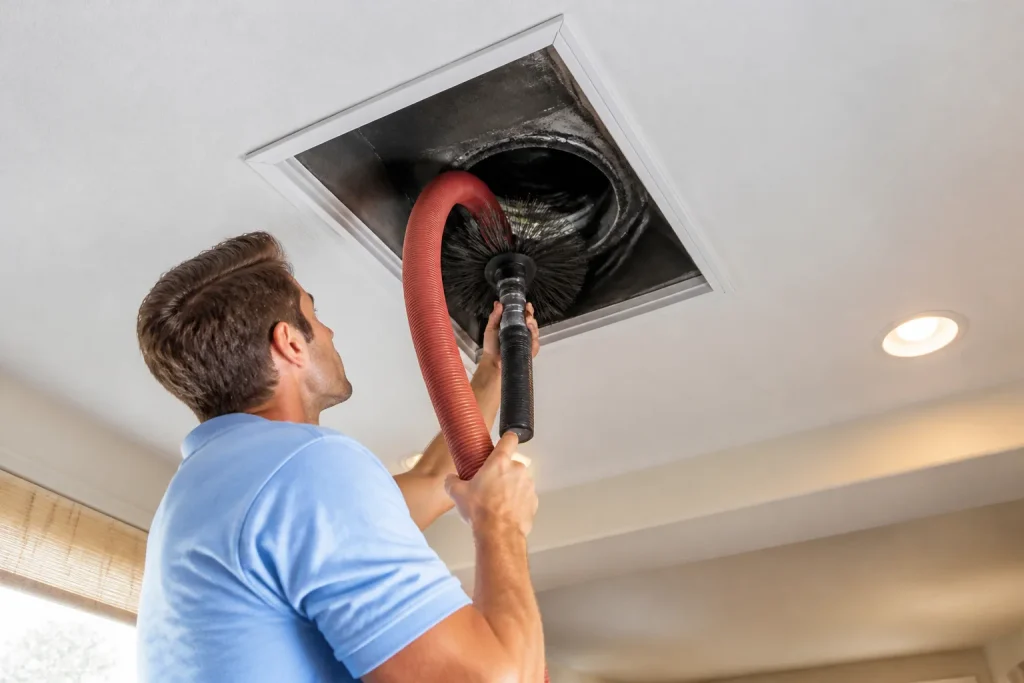
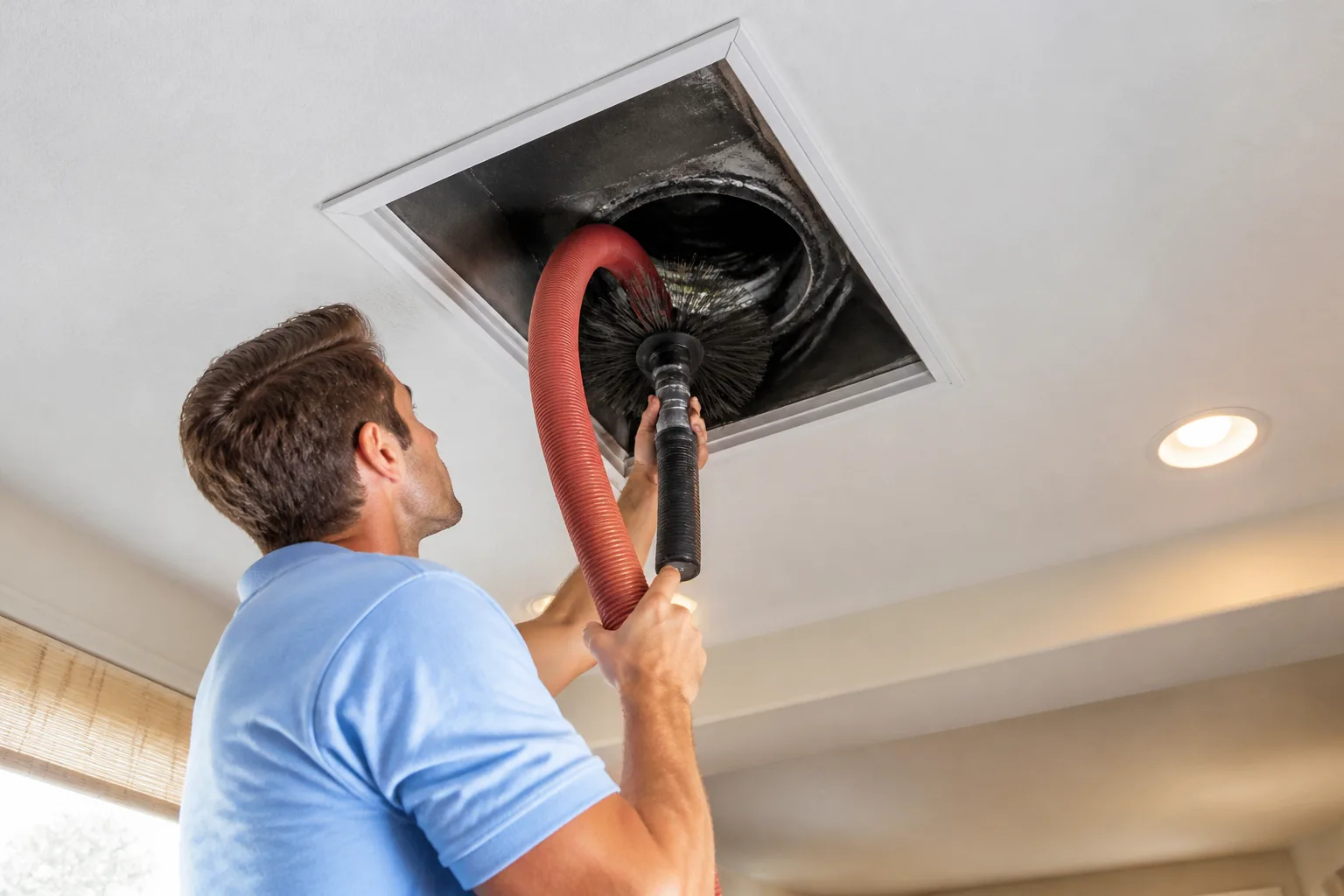
At this stage, a technician with a Rotobrush rotary brush system can tell you whether the debris is loose particulate or adhered material on the duct walls. Those are two different cleaning jobs.
Sign #2: A Musty Smell That Only Shows Up When the System Runs
This is the single most reliable diagnostic sign, and it’s easy to test. Turn the system off for an hour. Walk through the house. Smell anything? Now turn it on and wait five minutes. If the musty odor appears only when the air handler runs and fades when it stops, the source is almost certainly inside the duct system or on the evaporator coil. It’s being delivered to you by the airflow.
If the smell is there whether the system runs or not, look elsewhere. Wet basement carpet, a damp crawlspace, a bathroom exhaust that isn’t venting outside. Those are building-envelope problems and no amount of duct cleaning will fix them.
The mechanism behind a system-delivered musty smell is usually biological growth on the coil or in the insulated section of the duct. Condensation forms on the coil during cooling, and if that surface stays damp, it becomes a habitat. Dust feeding through the return gives it something to grow on. This is where air-quality sanitizing after cleaning does real work: cleaning removes the food source, sanitizing addresses what’s left on the surfaces.
Sign #3: Visible Growth at One Register vs. a System-Wide Odor
Spotting something growing around a single supply register in Kirkland is common, and it’s important to understand what it does and doesn’t tell you. A single affected register points to a localized condition: a cold spot, a small leak in the duct near that run, or condensation forming where that branch passes through an unconditioned space. That’s a scope of one.
A mold-like odor detectable throughout the house, or the same smell at multiple registers on different floors, points to a system-wide condition. Different cause, different urgency. In that case the growth likely started at the coil or in the trunk and spread through the branches. Cleaning one vent fixes nothing.
This is why we don’t treat cleaning and repair as separate visits from separate contractors. A technician inspecting the system will identify where the moisture is coming from, seal the breach or disconnection that’s letting humid air in, and clean the affected runs. Cleaning without fixing the moisture source just means the problem returns. Many Kirkland homes have ducts routed through crawlspaces and unconditioned attics, so a small break in the duct jacket can pull in outside air for years before anyone notices the smell.
Sign #4: Allergy Symptoms That Track With Your Thermostat
Pay attention to timing. If symptoms get worse in the hours after the system runs, and improve when the house has been closed up without the fan on, you’re not reacting to spring pollen. You’re reacting to something the system is stirring up. That pattern shift is worth taking seriously.
Particle size explains the rest. Larger dust and debris settle out in the ducts and never reach your breathing zone. The particles that cause symptoms are small enough to stay airborne, and those travel through the trunk line and past the filter before they reach you. A MERV 8 filter captures a meaningful share of what passes through it, but it can’t do anything about contamination that’s already downstream in the trunk, branches, or blower compartment. Filters are preventive. They’re not a remedy for a system that’s already loaded.
What actually helps, in order: remove the debris load through a full air duct cleaning, verify the system is sealed so unfiltered air isn’t bypassing the filter at a disconnected joint, and then upgrade filtration or add a media cabinet if the goal is ongoing improvement. Honeywell and Aprilaire filtration products are the ones we’re authorized to recommend and install, and they’re worth discussing with your HVAC tech if symptoms are a recurring Kirkland issue in your home.
Sign #5: The System Runs Longer Than It Used To
This is the sign almost nobody writes about, and it shows up on your energy bill before it shows up as a comfort complaint. Debris on the evaporator coil or in the blower compartment restricts airflow. Restricted airflow raises static pressure in the system. Higher static pressure forces the blower to work harder and run longer to move the same volume of air. You feel nothing, but the runtimes creep up.
Watch for short cycling too. A system that starts and stops in short bursts, or one that runs much longer than it used to on a mild day, is telling you airflow is compromised somewhere. It could be a dirty filter, a failing blower, or a coil matted with debris and dust. A technician can measure static pressure and tell you which one it is.
When we clean a system, we use Nikro HEPA vacuum equipment and Abatement Technologies air-filtration units to capture dislodged contaminants at the source rather than pushing them into your living space. That matters for a coil cleaning job specifically, because dislodging debris from a wet coil without source containment sends it straight into the return.
One more sign worth knowing: a dryer vent cleaning that’s overdue shows up the same way. Lint buildup restricts exhaust airflow and forces the dryer to run longer. It’s also a fire risk, which is why we treat it as its own dedicated service rather than an add-on. If your dryer takes two cycles to finish a load, that’s the signal.
When to Call a Pro
Call a professional when a symptom has a mechanism behind it that you can’t resolve yourself. Dust returning in two days, a smell tied to system operation, visible growth, symptoms that track with HVAC runtime, or runtimes that have crept up. Those are indicators, not guesses.
If you’ve ruled out the DIY checks and want a full assessment, we handle the whole duct system, including HVAC cleaning and duct repair and sealing, so you’re not coordinating three contractors. Call (855) 812-5163. We answer 24/7. Fast dispatch from 7am to 7pm, Sunday through Friday.
Related services in Kirkland: Kirkland Air Duct Cleaning for a full-system inspection and air-quality assessment.
The Bottom Line
Dust reappearing fast, a musty smell tied to system operation, growth at one register versus system-wide odor, symptoms that follow your thermostat, and rising runtimes are the five signs that point to a genuine need rather than routine housekeeping. Each one has a mechanism behind it, and each one is worth an inspection rather than a guess.
Our technicians have up to 11 years of experience reading those signals in Kirkland homes, and we use professional-grade equipment, including Rotobrush, Nikro, and Abatement Technologies, because a consumer vacuum can’t reach the trunk line or contain what it pulls loose. If you’re in Kirkland and need help, Kirkland Air Duct Cleaning offers free estimates. Call (855) 812-5163 to schedule an assessment.
Frequently Asked Questions
If dust returns to a clean register in 48 hours, or if you have a system-delivered odor, a filter change won’t fix it. Filters sit upstream of the problem. When contamination is already in the trunk, branches, or on the coil, only physical cleaning removes it. A brief inspection resolves the question quickly. Call (855) 812-5163 for an exact quote on an assessment.
No. A musty smell is only a duct sign if it appears when the system runs and fades when it stops. If the smell is constant with the system off, the source is usually outside the ducts, such as a damp crawlspace or carpet. Test it by running the system for five minutes after an hour off. Call (855) 812-5163 and we’ll help you narrow it down.
Yes, indirectly. Debris on the coil or in the blower compartment raises static pressure, which forces the blower to run longer for the same airflow. You notice it on the bill before you notice it in comfort. Measuring static pressure is the definitive test. Call (855) 812-5163 for a free estimate.
There’s no fixed interval that fits every home. A house with pets, recent remodeling, or a history of moisture issues tends to need it more often than a clean, well-filtered home. The practical answer is to act on symptoms rather than a calendar. If any of the five signs above apply, it’s worth a look. Call (855) 812-5163 and we’ll give you an honest read on whether your system needs it now.
Written by the team at Kirkland Air Duct Cleaning.
Need Air Duct Cleaning Help?
Call Kirkland Air Duct Cleaning - the local pro we connect you with is licensed and insured, here with fast help in Kirkland.
(855) 812-5163