
Emergency Air Duct Cleaning Near Me: What Kirkland Homeowners Should Do First
After a house fire, the instinct is to crank the thermostat and “clear the air.” That’s the wrong move. Running the HVAC pulls smoke particles and combustion byproducts into the return and pushes them out through every supply register in the house, so a problem confined to one room becomes a problem in all of them. If you’re facing smoke, sewage, or rodent contamination in your ducts right now, the first hour matters more than which company you call. Here’s what to do before anyone arrives.
If you’d rather not work through this alone, call (855) 812-5163. We answer 24/7, with fast dispatch from 7am to 7pm, Sunday through Friday.
What Actually Counts as an Air Duct Emergency in Kirkland?
A duct emergency is contamination that poses an active health or safety risk and gets worse the longer the system runs. Three situations qualify. Everything else is urgent, but it can wait for a scheduled visit.
The three genuine emergencies:
- Post-fire smoke and combustion byproducts. Smoke residue is acidic and settles into duct linings, insulation, and the blower assembly. Running the system redistributes it. This is the one case where you shut the HVAC off immediately and leave it off.
- Sewage or water intrusion into ductwork. Category 3 water carries pathogens. If it reached the ducts, the system is a contamination pathway, not just a moisture problem. Mold can establish in wet duct lining quickly in Kirkland’s damp fall and winter, when indoor humidity climbs and exterior walls stay cold.
- Confirmed rodent or pest nesting with droppings. Droppings and nesting material in a supply run mean the air you breathe passes over contaminated surfaces. This is a biohazard, not a housekeeping issue.
Urgent-but-not-emergency: musty odors, visible dust blowing from registers, a recent remodeling project that filled the returns with drywall dust, or a dryer that’s taking two cycles to dry a load. Those need prompt scheduling, not triage. If you’re unsure which category you’re in, that’s a reasonable question to ask on the phone. We’d rather talk you out of an emergency call than have you pay for one you didn’t need.
The First Steps for Each Scenario (Before a Technician Arrives)
Your job in the first hour is containment and documentation. Not cleaning. Don’t run a shop vac into a register, don’t spray anything into the ducts, and don’t start pulling grilles off. Disturbing contaminated material spreads it and can destroy the evidence your insurer needs.
After a fire or smoke event:
- Shut the HVAC system off at the thermostat. If there’s any question about the equipment itself, shut it off at the breaker too.
- Leave supply and return registers closed. If smoke is still present in the home, tape over registers with painter’s tape as a temporary barrier.
- Photograph everything before you touch it: registers, visible soot, the thermostat, any smoke staining near returns.
- Keep the system off until an HVAC technician inspects the blower, coils, and heat exchanger. Smoke residue on a heat exchanger is a safety concern, not just a cleaning one.
After sewage or water intrusion:
- Shut the system off. Wet duct lining plus airflow equals mold growth and pathogen distribution.
- Don’t run fans or a dehumidifier pointed at the ductwork until the source is confirmed.
- Photograph the water line, the affected registers, and any visible staining.
- Call your insurer before cleanup begins. Category 3 water is usually a covered loss, and the adjuster will want documentation.
With rodent activity:
- Shut the system off and keep it off. You don’t want droppings aerosolized through the house.
- Don’t sweep or vacuum droppings dry. That’s how hantavirus and other pathogens become airborne.
- Photograph droppings, nesting material, and any chewed duct connections you can safely see. Rodents chew through flex duct and disconnect joints, so a cleaning alone won’t fix it.
- Wear gloves and a respirator if you have to be near the material. Otherwise, stay out of the space.
Why Emergency Duct Work Often Needs More Than One Trade
Real contamination events rarely stop at the ducts. A fire leaves residue on the evaporator coil. Sewage backup usually involves a wet HVAC plenum and possibly compromised insulation. Rodents chew duct connections and sometimes wiring. A full-system specialist can handle the duct cleaning, sanitizing, and repair, but there are jobs that belong to someone else, and a good provider will tell you so.
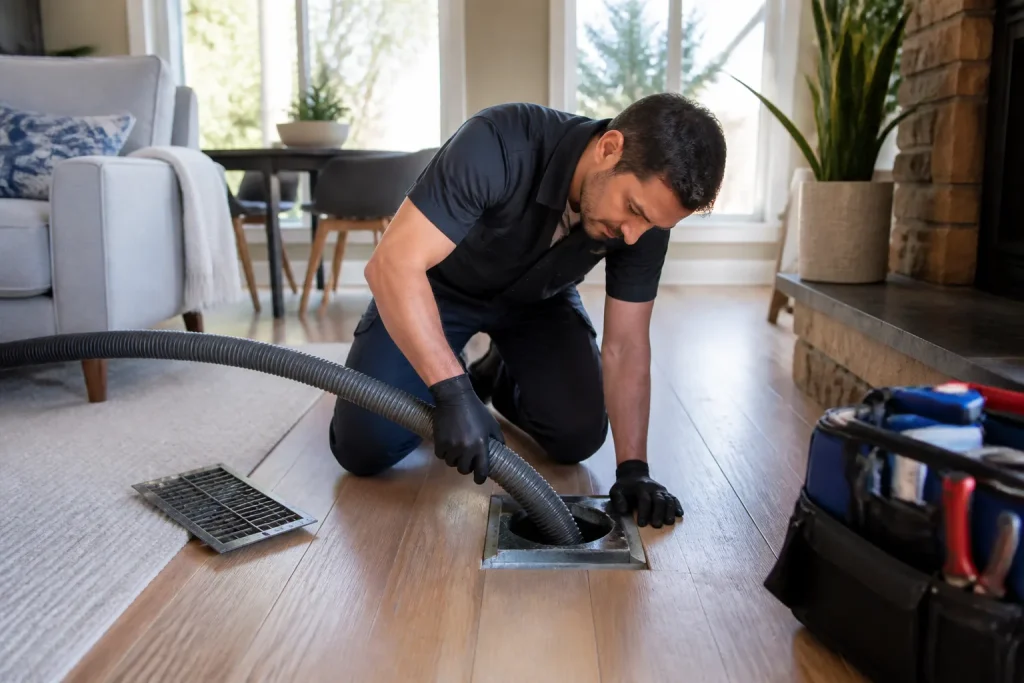
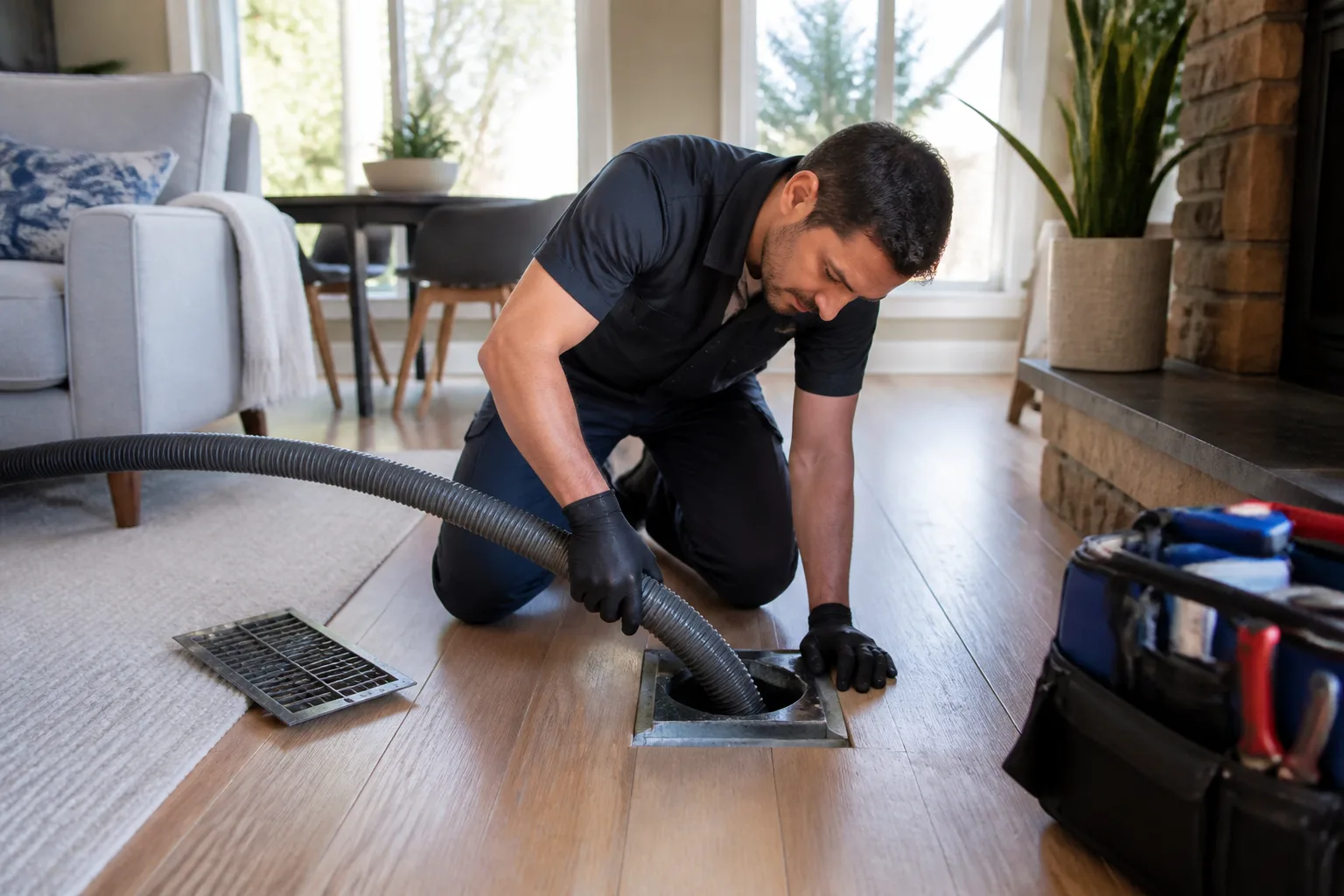
What we handle: cleaning and sanitizing the duct system with professional-grade equipment, including Nikro HEPA vacuum systems and Abatement Technologies air-filtration tools that capture dislodged contaminants at the source. We also repair and seal what we find, because a disconnected duct or a chewed joint just recontaminates the system after cleaning. Post-cleaning verification includes visual camera inspection inside the runs, and where it matters, air quality testing.
What needs a different trade: coil and heat exchanger inspection after fire or smoke, mold remediation beyond the duct system itself, structural repairs, and electrical work after a rodent chew. Coordinating those trades is part of a realistic scope. Anyone who tells you one company can do all of it is either subcontracting quietly or overpromising.
What to Tell the Dispatcher When You Call
An accurate scope starts with a few details. Have these ready before you dial, and the estimate you get will be closer to the real number.
- Home size and layout. Square footage, number of floors, and roughly how many registers. A 1,400-square-foot rambler in Kirkland’s Market neighborhood and a three-story home near Juanita need different scopes.
- Type of contamination event. Fire, smoke, water, sewage, rodent. Be specific about what you saw and where.
- When it happened. How long the system ran after the event matters. So does whether it’s been off since.
- Whether the HVAC has been run since. This changes the contamination footprint entirely.
- Insurance status. Whether you’ve filed a claim and whether an adjuster has visited.
If you’re in Kirkland and need Kirkland Air Duct Cleaning to assess a contaminated system, call (855) 812-5163. We answer 24/7. A call outside dispatch hours is booked into the next opening, Sunday through Friday, 7am to 7pm.
How Remediation-Grade Cleaning Differs from Routine Maintenance
Maintenance cleaning removes accumulated dust and improves airflow. Remediation cleaning removes a hazard, and the process is different at every step. The equipment matters, the containment matters, and the verification matters most of all.
On a routine air duct cleaning visit, we run rotary brush systems and HEPA extraction, then show before-and-after photos of your own system. On a remediation job, we establish negative pressure and filtration before we open a single register. Rotobrush rotary systems agitate the duct walls while Nikro HEPA units hold the contaminant at the source. Abatement Technologies air-filtration equipment keeps the work area under control. Sanitizing follows cleaning, not the other way around. If someone offers to fog your ducts without cleaning them first, that’s a spray over a mess.
We also recommend air-quality products like Honeywell and Aprilaire filtration and humidification where the home’s air quality justifies it, and Guardsman components where a system needs a replacement part. Those are add-ons, not requirements, and on a remediation job we’ll tell you honestly whether they’ll do anything for your situation.
Verification is where remediation and maintenance really diverge. After a repair-and-seal job, we camera-inspect the runs to confirm the joints are closed. After a contaminant event, we check that the surfaces are clean and the system is holding pressure. You shouldn’t have to take anyone’s word for it. Ask for the photos.
When to Call a Pro Instead of Handling It Yourself
If your ducts have seen fire, sewage, or rodent contamination, call. This isn’t a shop-vac job. Consumer equipment doesn’t reach the duct walls, doesn’t contain what it dislodges, and doesn’t verify the result. And the material itself can be hazardous to handle without the right protection. Our technicians have up to 11 years of experience, and the local pro we connect you with is licensed and insured as their state requires.
On a Kirkland home, some of this is seasonal. Late fall and winter bring indoor humidity up and windows closed, which is exactly when a compromised duct system makes itself known through odor and stale air. If you’re seeing that pattern, a scheduled visit is the right move. If you’re seeing smoke, sewage, or droppings, call now.
Related services in Kirkland: dryer vent cleaning for the fire-safety side of the same system, and HVAC cleaning when the blower and coil are part of the contamination footprint.
The Bottom Line
Contain first, document second, call third. That order protects your health, your home, and your insurance claim. Routine dust and musty smells can wait for a scheduled appointment. Fire, sewage, and rodent contamination can’t. And whatever you do, resist the urge to run the HVAC to “air things out” after a smoke event. Most homeowners learn that one the hard way, which is how the repair bill grows.
If you’re in Kirkland and need help, Kirkland Air Duct Cleaning offers free estimates. Call (855) 812-5163. We answer 24/7. Fast dispatch from 7am to 7pm, Sunday through Friday.
Frequently Asked Questions
Yes. Shut the system off at the thermostat immediately after a fire or smoke event. Running it pulls smoke particles and combustion byproducts into the ducts and distributes them through every room. Leave it off until an HVAC technician has inspected the blower, coils, and heat exchanger. Call (855) 812-5163 to schedule an assessment.
Look for droppings, nesting material like shredded insulation or paper, and chew marks near registers or duct connections. A musty or ammonia-like odor near a register is another sign. Don’t sweep or vacuum dry droppings. Shut the system off and have it inspected. Call (855) 812-5163 for an estimate.
Often it will, if the contamination came from a covered event like a fire, burst pipe, or sewage backup rather than neglect. Photograph everything before you disturb it and contact your insurer before cleanup. The written estimate from us gives your adjuster a documented scope. Call (855) 812-5163 to get that started.
Longer, because containment, sanitizing, and post-cleaning verification each add a step. A routine cleaning on a typical Kirkland home is usually a half-day. A fire, sewage, or rodent remediation job can run a full day or more, and may involve a follow-up visit to confirm the repair held. Call (855) 812-5163 for a scope and estimate.
Written by the team at Kirkland Air Duct Cleaning.
Need Air Duct Cleaning Help?
Call Kirkland Air Duct Cleaning - the local pro we connect you with is licensed and insured, here with fast help in Kirkland.
(855) 812-5163